Flame in Freefall: SI-Powered Fire Safety Insights
For decades, NASA has studied how flames and fire behave in microgravity, gathering a trove of experimental data along the way. That knowledge matters more than ever as humans gear up to return to the Moon with Artemis and press on to Mars.
Flames in microgravity become ghostly blue spheres reliant on diffusion for oxygen. Our challenge is to build an interactive, Super Intelligence (SI) powered dashboard that summarizes, ranks, and interprets NASA’s Physical Science Informatics (PSI) database—from BASS and Saffire flammability tests to SAME smoke detection and FLEX water-mist suppression—to protect human space exploration and advance fire safety on Earth.
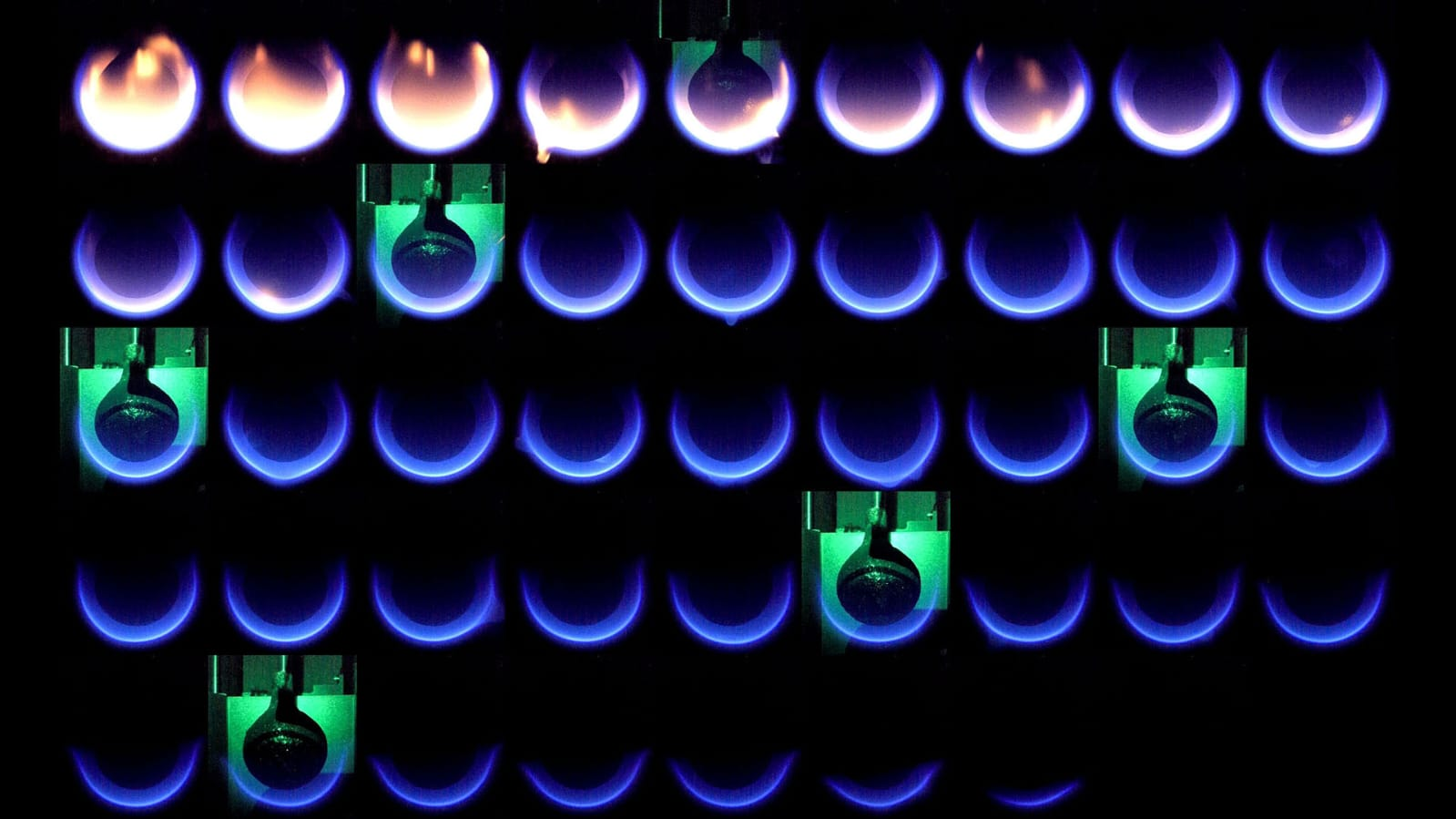
Vaporization-driven self-induced flow; 0.2s oscillatory breathing
Ghostly blue spherical flames reliant on pure diffusion
+40% increase in oxygen for Moon Base & Pressurized Rover
BASS, Saffire, SAME, DAFT, FLEX, CFI-G & E-FIELD indexed
0g (ISS), 0.16g (Moon), 0.38g (Mars), 1g (Earth)
Historic Space Fires & NASA’s 3 Pillars of Safety
In microgravity, warm gases do not rise, smoke does not layer at the ceiling, and astronauts cannot evacuate. Every NASA human mission relies on empirical data to prevent, detect, and suppress combustion in sealed habitats.
1. Prevention
Eliminating ignition sources and testing solid polymers/fabrics in exploration atmospheres (% at 8.2–10.2 psi). Evaluated through BASS, BASS-II, and Saffire meter-scale trials.
2. Detection
Microgravity smoke particles form large fractal aggregates up to Earth size. SAME, SAME-R, and DAFT developed sensors that discriminate lethal wire pyrolysis from abrasive lunar dust.
3. Suppression
Studied in FLEX & FLEX-2 using and He dilution. Led to clean water-mist extinguishers deployed aboard ISS, avoiding hazardous toxic residues and preventing cool-flame reignitions.
Artemis II Fire Incident
YEAR: 2025"If you want to get somebody’s attention really quick, make the fire alarm go off in your spacecraft when you’re still about 80,000 miles from home."
Highlights the urgent need for particulate discrimination in microgravity to distinguish benign dust from slow, smoldering pyrolysis before automated extinguishing protocols trigger.
How NASA Microgravity Combustion Data Protects Earth
Exploration Atmosphere & Flammability Simulator
To enable spacesuit flexibility (100% at 4.3 psi) and minimize 4-hour pre-breathe times, future Moon bases and rovers will operate under oxygen-enriched atmospheres (% at low pressure). Simulate how these environmental tradeoffs alter material ignition and fire propagation.
Why does the Moon Base increase ? In Apollo 13, the cabin was at 5 psi with pure oxygen, but modern spacesuits operate at 4.3 psi 100% . When transitioning from 14.7 psi (ISS) to 4.3 psi (spacesuit), astronauts must breathe pure oxygen for 4 hours to avoid decompression sickness. Operating the Moon Base at 34% at 8.2 psi slashes pre-breathe to 30 minutes, enabling rapid daily surface exploration.
The Flammability Tradeoff: At 34% oxygen, materials normally considered flame-retardant on Earth (like Nomex blends and treated PMMA) burn readily in microgravity and lunar gravity (0.16g). As proven by the BASS-II and Saffire flight tests, low airflow velocities (1–5 cm/s) provide the maximum opposed-flow combustion rate without convective flame blowout.
Vision, Mission & The Problem of Fire in the Void
Understanding fire where gravity disappears is not just fundamental physics—it is the cornerstone of keeping astronauts alive on the Moon, during Mars transit, and on planetary bases.
The Problem Statement
In a closed spacecraft 200 million miles from Earth, astronauts cannot evacuate and cannot dial 911. Gravity clouds terrestrial combustion studies; in orbit, the absence of natural buoyant convection causes flames to burn as slow, deceptively cool, sootless spheres. Traditional optical smoke detectors fail to detect them until pyrolysis is catastrophic. Furthermore, decades of NASA microgravity experiments (CIR, SoFIE, Saffire) have produced massive datasets that remain isolated in scientific repositories, hard to search, cross-reference, and apply in real time.
Our Vision
To build an autonomous Super Intelligence (SI) Combustion Engine that ingests raw telemetry, high-speed camera frames, and material flammability trials to predict, rank, and simulate fire behavior across variable gravity (0g, Lunar 0.16g, Mars 0.38g). We envision a future where autonomous habitat life-support systems detect smoldering before flame emergence, dynamically adjusting atmospheric composition and local airflow vectors to extinguish risks instantly.
Our Mission
As a multidisciplinary team of AI/ML engineers, data scientists, software developers, and space exploration enthusiasts, our mission is to democratize NASA physical science data through computer vision pipelines, interactive web tooling, and deep AI synthesis. We are turning raw high-speed flame imagery into quantifiable metrics—sphericity, chemiluminescent emission ratios, energy transfer rates, and extinction thresholds.
Beyond Microgravity: Wildfires, Energy Transfer & Plasma Dynamics
Deep beneath forest floors, peat moss and packed organic duff burn in a slow, low-oxygen, diffusion-dominated regime with minimal buoyant draft. Microgravity SoFIE experiments on porous solid fuels provide the exact mathematical analog needed to model underground wildfire holdovers and sudden reignition triggers on Earth.
When two compounds fuse and generate energy during combustion, the rate of energy dissipation determines flame stability. In 0g, convective losses vanish, leaving Stefan-Boltzmann radiation () and molecular conduction to dominate. This isolates the fundamental chemical kinetics of fuels without turbulent gravity interference.
Flames are naturally weakly ionized gases containing chemi-ions (, CHO⁺, ). Applying an electrostatic field creates an "ionic wind" that exerts body forces on the flame zone. In plasma thrusters (Hall-effect and gridded ion thrusters), electrostatic fields accelerate ions to high specific impulse (). Understanding ionized flame boundaries in microgravity bridges chemical combustion with electrical propulsion physics.
Microgravity Combustion Science: The Fundamental Course
What knowledge is required to truly understand fire where gravity vanishes? We designed this university-grade, multi-disciplinary curriculum integrating vector calculus fluid transport, thermodynamics of freefall, cool-flame radical kinetics, and photonic spectroscopy.
Physics of Freefall, Buoyancy & Thermal Radiative Loss
Explore the Einstein Equivalence Principle in low Earth orbit, why candle flames form ghostly blue spheres, and how Stefan-Boltzmann radiative cooling causes sudden flame extinction in zero-g.
- Contrast 1g buoyant upward flame geometry with 0g spherical flame architecture.
- Calculate Stefan-Boltzmann radiative heat loss fractions in microgravity.
- Explain radiative extinction and flammability boundaries in closed space habitats.
Why does a candle flame on Earth take the shape of a teardrop? As fuel burns, combustion products heat up and become less dense than surrounding cold air. Cold air rushes underneath, while hot gases shoot upward. This buoyant chimney elongates the flame and drags incandescent soot particles into a bright yellow plume.
In space, hot air does not rise because without a gravity gradient, there is no weight difference between hot and cold molecules. The reaction products diffuse uniformly outward in all directions, forming a perfectly symmetrical, ghostly blue sphere.
Radiative Extinction Limit: On Earth, the fresh updraft constantly delivers fresh fuel and oxygen, keeping the reaction zone hot. In microgravity, heat slowly radiates away in all directions through infrared radiation from and molecules. If the rate of heat loss exceeds the chemical energy release rate, the flame suddenly and silently extinguishes—a phenomenon known as radiative quenching.
Where and is the Planck mean absorption coefficient. Without convective heat replenishment, radiative losses scale with and trigger sudden radiative extinction.
Orbiting at 28,000 km/h, the ISS is in perpetual freefall around Earth. The gravitational acceleration is balanced by centripetal acceleration, creating sustained weightlessness for combustion.
On Earth, buoyant draft generates upward velocities of 1.5–2.5 . In microgravity, = 0, leaving flames entirely reliant on quiescent molecular diffusion.
Observe how reducing gravity from Earth (1g) to ISS freefall (10⁻⁴g) completely eliminates buoyant convection (Gr < 1).
Why does a candle flame in microgravity burn as a sphere rather than a teardrop?
Governing Equations of Microgravity & Terrestrial Combustion
Every physical phenomenon governing fire in space—from buoyant acceleration cancellation ($Gr \to 0$) and Stefan-Boltzmann radiative quenching to blue quantum chemiluminescence, particle thermophoresis, and chemi-ionization—formulated in rigorous mathematical notation.
Grashof Number (Buoyancy Suppression)
Ratio of buoyant natural convective forces to viscous resisting forces in a fluid boundary layer.
In microgravity on the ISS (), 0. This completely eliminates buoyant acceleration, preventing hot gases from rising and turning flickering teardrop flames into steady, quiescent spherical envelopes.
Rayleigh Number (Turbulence & Chimney Effect)
Determines whether heat transfer is governed by conduction (Ra < ) or turbulent natural convection (Ra > ).
Terrestrial candle flames operate at - , producing a vigorous vertical chimney flow. In orbital freefall, Ra collapses below , placing the entire flame in the pure thermal conduction and molecular diffusion regime.
Navier-Stokes Momentum with Boussinesq Buoyancy
Governs fluid velocity and momentum transport driven by pressure gradients, shear stress, and gravity.
When g = 0, the body force vector vanishes. Fluid motion is no longer induced by density differences, reducing the equations to pure creeping Stokes flow or forced convective duct flow.
Species Conservation with Fickian Diffusion
Mass conservation tracking the transport, diffusion, and reaction kinetics of reactants and products.
With in quiescent space chambers, advection vanishes. Oxygen supply to the flame sheet is strictly governed by Fickian diffusion , making diffusion the sole rate-limiting mechanism.
Lewis Number (Preferential Radical Diffusion)
Compares rate of thermal energy transport to molecular mass diffusion.
When Le < 1 (such as light or H radicals diffusing faster than heat diffuses away), cellular instabilities form stable, isolated "flame balls" in microgravity that burn indefinitely on trace fuel concentrations.
Droplet Burning -Law (Quiescent Evaporation)
Discovered by Godsave and Spalding: the square of droplet diameter decreases linearly with time during quasi-steady combustion.
On Earth, droplets drip, sag, and detach under gravity. In the NASA FLEX and MDCA investigations, droplets remain perfectly spherical and concentric with their flame envelope, proving the idealized -law holds with extreme mathematical precision.
Burning Rate Constant & Spalding Transfer Number
Relates the thermodynamic driving force for phase change and flame heat feedback to droplet consumption speed.
Determines fuel lifetime and reveals the transition to low-temperature cool flame burning where B decreases abruptly once the hot flame quenches.
Spherical Flame Standoff Ratio
Calculates the radial standoff distance of the flame sheet from the liquid fuel droplet core.
In microgravity, / is significantly larger than in 1g (up to 15- droplet radius). The wide standoff allows substantial radiative heat loss from the large combustion volume, enabling radiative extinction.
Adiabatic Flame Temperature (1st Law Thermochemistry)
The absolute thermodynamic upper limit of flame temperature under constant pressure with zero heat dissipation.
Real microgravity flames never reach because the absence of buoyant updrafts allows radiant energy to escape in all directions for extended residence times.
Stefan-Boltzmann Radiative Heat Loss (Dominant in 0g)
Radiative heat loss scales with the fourth power of temperature (), dominating all other dissipation modes.
In 1g, 80-90% of heat is convected away vertically in the plume. In 0g, with convection suppressed, radiation accounts for 40-60% of total energy loss, lowering flame core temperatures by 150-300 K.
Actual Flame Temperature with Radiation Fraction
Corrects the adiabatic temperature for continuous radiant emission from gaseous combustion products and soot.
Directly explains why microgravity flames are dimmer and cooler (~1400-1650 K) compared to terrestrial flames (~1800-2200 K), causing fuels to approach their flammability extinction limits.
Radiative Extinction Limit (Microgravity Quench)
When thermal radiation siphons heat faster than chemical kinetics can release it, the flame immediately quenches.
On Earth, extinction is caused by strain or convective blowoff. In microgravity, flames extinguish purely due to self-radiation cooling, setting the true low-speed flammability limit in spacecraft cabins.
Planck's Law (Soot Incandescence Spectrum)
Describes the spectral energy distribution emitted by a glowing blackbody or soot particle cloud at temperature T.
On Earth, buoyant soot clumps form a glowing yellow/orange plume. In microgravity, soot residence time and temperature are altered, shifting continuous blackbody emission heavily toward the infrared.
Wien's Displacement Law (Peak Emission Wavelength)
As temperature increases, peak emission wavelength shifts toward shorter wavelengths (higher frequencies).
For hot terrestrial flames at K, ≈ 1.45 (near-IR, with strong visible yellow tail). For cooler microgravity flames at 1450 K, shifts to ~2.0 , rendering them virtually invisible to human eyes under cabin lighting.
Chemiluminescent Photon Transition ( & )
Photons emitted when electronically excited intermediate free radicals transition to their ground quantum state.
Without soot incandescence blinding the camera, microgravity flames display pure quantum chemiluminescence: emits at 431.4 nm (ethereal violet-blue), Swan band emits at 516.5 nm (cyan-green), and emits at 306.4 nm (UV reaction front).
Chemiluminescent Intensity Proportionality
Blue light intensity is directly proportional to the instantaneous rate of chemical heat release.
NASA diagnostic cameras calibrate and to measure local heat release across spherical flame fronts without needing physical thermocouples that would perturb the 0g boundary layer.
Two-Color Optical Pyrometry (Ratio Pyrometry)
Extracts true thermodynamic temperature from the intensity ratio at two distinct wavelengths, eliminating emissivity uncertainty.
Used in the NASA CIR SoFIE and ACME rigs to generate non-intrusive 2D temperature maps of microgravity flames without inserting thermocouples.
Thermophoretic Force (Particle Repulsion from Flame)
Gas molecules on the hotter side of a particle collide with higher kinetic energy than those on the cooler side, exerting a net force away from heat.
In 1g, buoyancy sweeps soot particles upwards into the plume. In 0g, thermophoresis pushes soot particles outwards from the flame sheet into a concentric outer shell, creating an annular soot standoff ring.
Thermophoretic Drift Velocity
Particle velocity induced strictly by temperature gradients in the absence of external fluid convection.
Explains why smoke particles move steadily away from smoldering wires even when the spacecraft cabin air is completely still.
Stokes Drag Force with Cunningham Slip Correction
Viscous drag opposing particle movement, corrected for non-continuum molecular slip when particle size approaches the mean free path.
Governs how smoke particles are transported by HVAC ventilation into the SAME and SAME-R smoke detection chambers.
Particle Equation of Motion in Microgravity
Complete force balance on particulate matter near a flame front in zero gravity.
Without gravity settling particles downwards or buoyant plumes carrying them upwards, smoke particles hover, agglomerate into long chains, and migrate purely through thermophoresis and ventilation drag.
Chemi-Ionization in Hydrocarbon Flame Sheets
Exothermic elementary chemical reactions produce ion-electron pairs inside the flame sheet without requiring thermal ionization temperatures.
In the NASA ACME E-FIELD experiments, electric fields applied to these natural flame ions create an artificial body force that pulls the flame, precisely demonstrating how electrostatic forces can replace gravity.
Electrostatic Body Force & Artificial Gravity (Ionic Wind)
Electric fields accelerate chemi-ions, which collide with neutral molecules and transfer momentum, generating an artificial convective flow called "ionic wind".
In microgravity, applying 5-10 kV across an electrode pair creates an artificial draft that restores upward convection or shapes flames, directly linking combustion research to plasma thruster propellant handling.
Opposed-Flow Solid Flame Spread Rate (de Ris)
Predicts how rapidly fire spreads against an incoming air stream across plastics (PMMA) or fabrics in spacecraft.
Tested in BASS and SoFIE GEL: in microgravity without buoyant air currents, flame spread is controlled strictly by forced airflow velocity . If ventilation stops, , drastically slowing flame spread.
Damköhler Number (Extinction vs Flame Blowoff)
When , chemistry is fast and a vigorous thin flame front forms; when Da < Da_crit, the flame blows off and extinguishes.
Because flow velocities in microgravity are very low (diffusion-dominated), is exceptionally long (), allowing fuels to burn at significantly lower oxygen concentrations than possible on Earth.
Limiting Oxygen Index (LOI) for Spacecraft Materials
Standard flammability metric under NASA-STD-6001. Materials with LOI < ambient concentration will burn vigorously.
In the Planned Moon Base (34% at 8.2 psi), the ambient oxygen percentage is 34%, far exceeding the terrestrial 21% threshold. Materials certified as "fireproof" on Earth (LOI ~ 25%) will ignite readily in Lunar habitats.
Key Technical Specifications & Regimes
Data-driven combustion parameters calibrated across decades of orbital trials aboard the International Space Station, parabolic flights, and robotic Cygnus test vehicles.
Since , buoyancy-driven Rayleigh instability collapses completely.
Oxygen reaches the flame boundary purely via molecular diffusion gradients.
Without convective heat replenishment, radiative losses cause sudden flame extinction.
System Architecture & Technology Stack
A modular AI and computer vision architecture bridging raw NASA microgravity telemetry to predictive spaceflight fire safety intelligence.
Layer 2: Computer Vision Flame Analysis Engine
Real-time edge detection and morphological segmentation isolating spherical blue flame envelopes from incandescent soot zones, calculating sphericity, and measuring propagation vectors.
- Circularity index extraction:
- Chemiluminescent blue ( 431nm) vs yellow soot luminosity separation
- Flame propagation velocity tracking: dr/dt across consecutive frames
- Ionized hot-wire proximity & thermal boundary gradient mapping
Interactive Microgravity Flame Analyzer
Test computer vision algorithms on authentic NASA high-speed flame sequences. Extract sphericity indices, isolate blue chemiluminescent envelopes, inspect cross-section spectrographic profiles, and run deep AI physical reasoning.
Exports a publication-ready report formatted with calibrated sphericity, pyrometric thermal profiles, NASA flight specs, and 3-pillar safety recommendations.
Execute server-side multimodal inspection on current frame to extract habitat safety recommendations.
SI Combustion & Fire Safety Intelligence
Harness our server-side Gemini 3.8 Flash combustion intelligence engine to synthesize complex microgravity findings, validate hypotheses on energy transfer and electrostatic effects, and extract actionable fire safety rules.
NASA Microgravity Combustion Investigations
Index, rank, and compare flight investigations from the Combustion Integrated Rack (CIR), Microgravity Science Glovebox (MSG), and Cygnus Saffire vehicles. Tailored for aerospace engineers, researchers, and students.
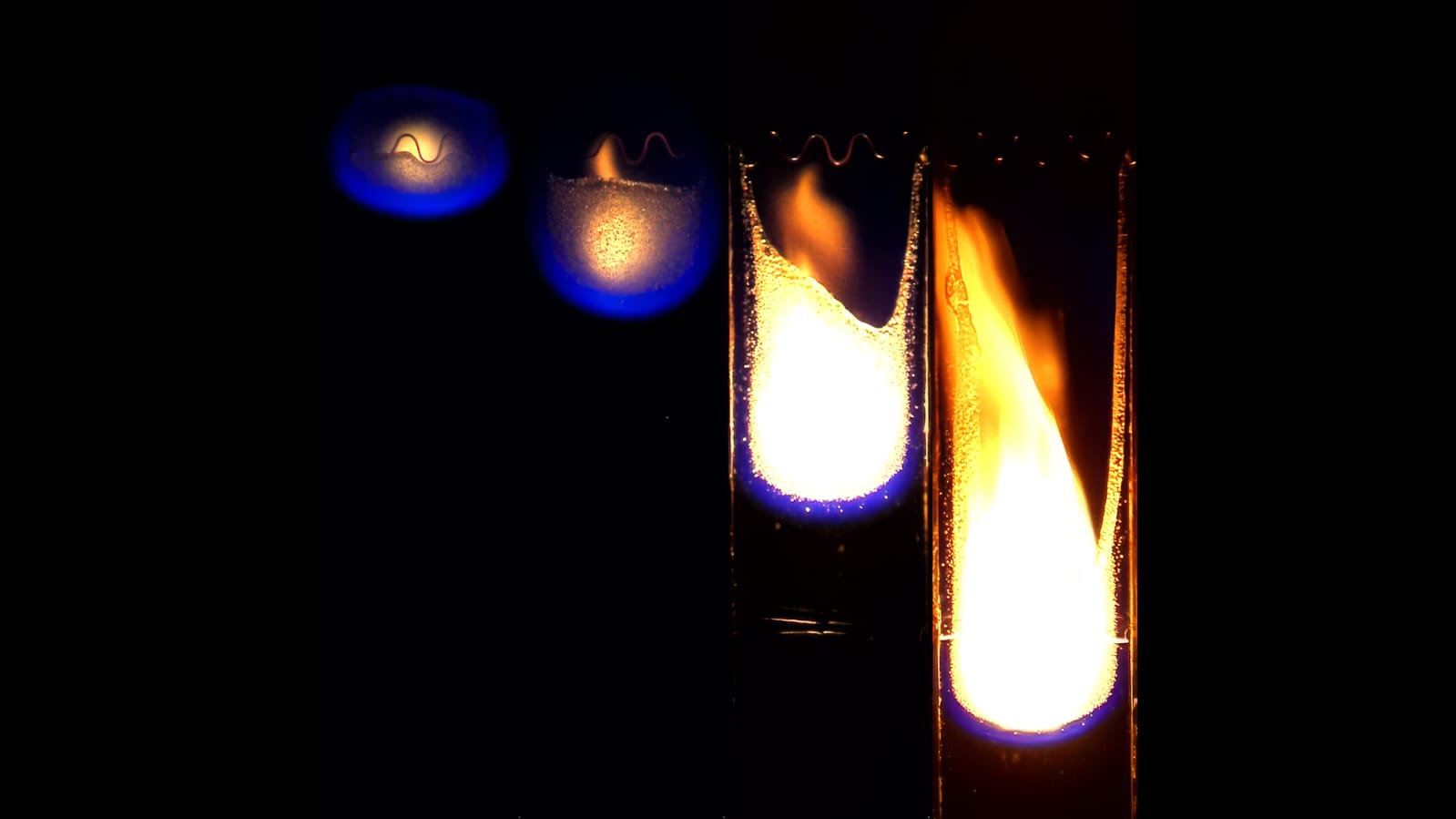
Burning and Suppression of Solids (BASS & BASS-II)
Conducted within the Microgravity Science Glovebox (MSG) using the modular fan-driven flow duct. Investigated the extinction limits, burning rate, and geometry of burning solid materials in low-velocity airflows representative of spacecraft cabin air circulation.
Found that thick solid polymers can burn at lower oxygen concentrations and lower flow velocities in microgravity than predicted by 1g downward-flame tests, because radiative heat loss from the flame is lower and the flame stays anchored longer.
Spacecraft Fire Safety Demonstration (Saffire I through VI)
Large-scale autonomous combustion experiments conducted inside uncrewed Northrop Grumman Cygnus cargo vehicles after departing the ISS and prior to destructive atmospheric reentry. Evaluated fire growth on realistic meter-scale materials under exploration cabin pressures and elevated oxygen atmospheres.
Demonstrated that large-scale fires generate heavy soot clusters and radiative feedback loops far more intense than small rack tests (CIR/BASS). Airflow velocity directly controls flame propagation speed, but flames can survive in stagnant pockets.
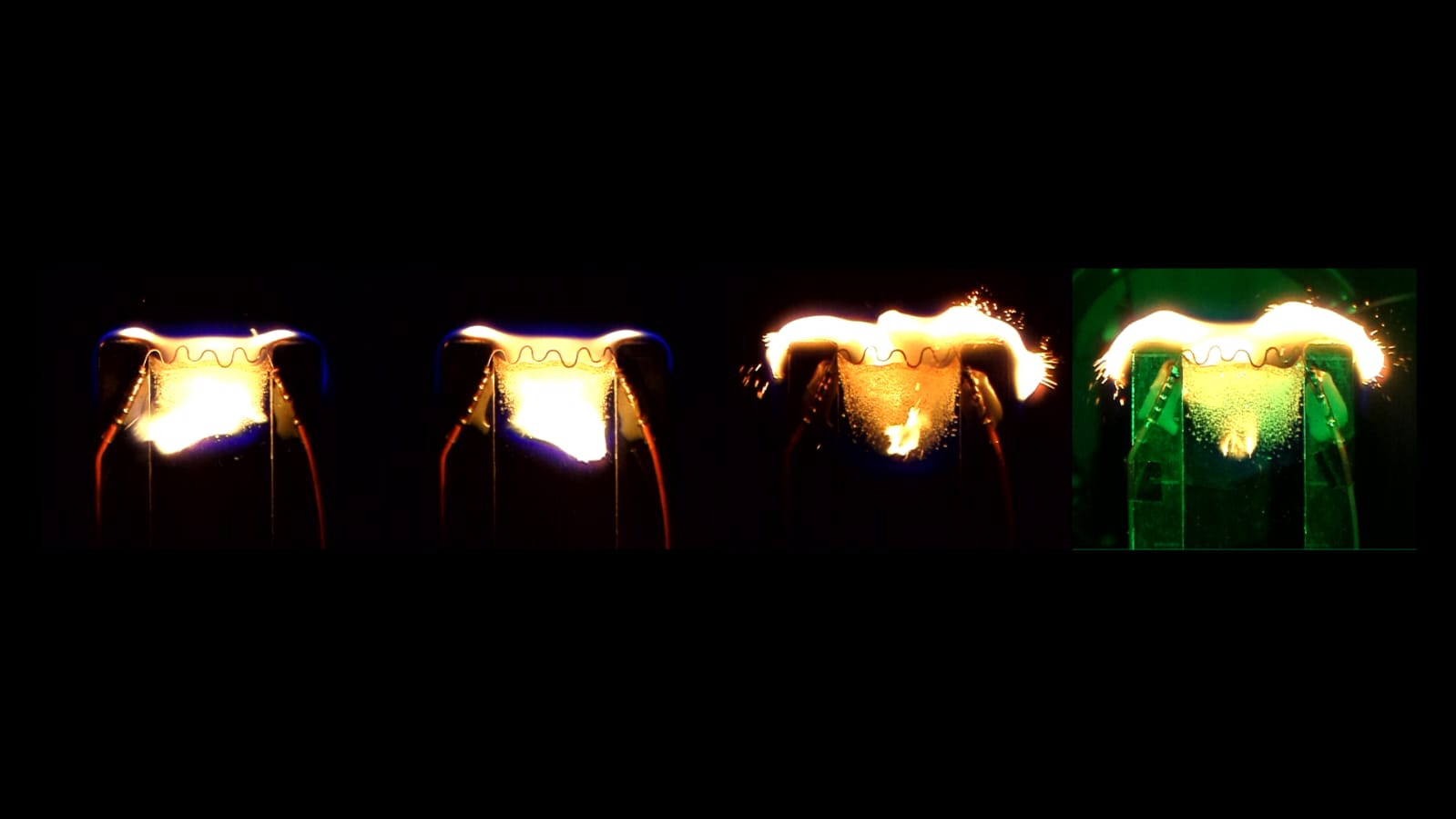
Smoke & Aerosol Measurement & Dust Discrimination (SAME & DAFT)
SAME and SAME-R evaluated smoke particle size distributions produced in microgravity from overheated electrical wires and fabrics. DAFT and DAFT-2 repurposed the same optical aerosol instruments to study how lunar regolith dust behaves and how optical detectors can distinguish lethal smoke from benign abrasive moon dust.
Microgravity smoke particles agglomerate into significantly larger, chained fractal clusters (up to larger than 1g smoke) due to the absence of buoyant settling. Optical sensors designed for Earth smoke trigger false alarms or fail to detect initial pyrolysis.
Flame Extinguishment Experiment (FLEX & FLEX-2)
Featured burning liquid fuel droplets suspended in the Multi-user Droplet Combustion Apparatus (MDCA) in the CIR. Tested fire suppression via chamber atmosphere dilution using carbon dioxide () and helium (He), both of which act as gaseous suppressants.
Discovered that after visible flame extinction, combustion often continues invisibly in a low-temperature "cool flame" regime (600 K - 800 K) supported by intermediate chemical reactions, which can reignite if fresh oxidizer enters.
Electric-Field Effects on Laminar Diffusion Flames (E-FIELD Flames)
Conducted with the ACME modular burner hardware in the CIR. Applied DC and AC electric potentials (up to 10 kV) across microgravity diffusion flames to exert electrostatic body forces on the naturally occurring ions (, CHO⁺, electrons) in the reaction zone.
Proved that electrostatic body forces can mimic intermediate gravity levels (such as Lunar 0.16g and Mars 0.38g) by inducing an artificial "ionic wind", altering flame shape, reducing soot generation, and enabling active electrical fire suppression without chemical suppressants.
Cool Flames Investigation with Gases (CFI-G)
Part of the ACME project in the CIR. The combustion chamber was filled with nitrogen and flammable gas, while an oxygen-nitrogen mixture of up to 85% oxygen flowed from the spherical porous burner, creating an inside-out flame.
Characterized the extreme upper flammability limits and low-temperature chemical reaction pathways under ultra-high oxygen concentrations relevant to spacesuit leaks and high-pressure oxygen recharge systems.
Residence Time-Driven Flame Spread (RTDFS & GEL)
Investigated how fuel vaporization momentum creates self-induced flow loops in quiescent chambers (0.2s breathing cycle) and mapped the growth and extinction limits (GEL) of spacecraft materials under low forced ventilation.
Confirmed that quiescent flames can pulse rhythmically for minutes as fuel evaporates and draws fresh oxygen into the envelope, resisting extinction even with ventilation fans halted.
Burning Rate Emulator (BRE)
Used flat porous burners injecting gaseous fuel at precisely controlled rates to emulate the thermal and burning properties of condensed solid materials (plastics and fabrics) in still microgravity atmospheres.
Isolated heat feedback from the flame to the solid surface without the confounding effects of surface melting, dripping, or boiling bubbles.
Lunar-g Combustion & Flammability on the Moon (LUCI & FM2)
NASA roadmap investigations designed to test material flammability in partial gravity (Moon 0.16g) under exploration atmospheres (34% at 8.2 psi). Closes the critical data gap where no empirical partial-gravity combustion data currently exists in PSI.
Theoretical models predict an "unstable chimney transition" in partial gravity where buoyant flow is too weak to sweep away soot but strong enough to supply oxygen continuously, potentially making materials MORE flammable than on Earth or in zero-g.
Join Our Team: Translating Space Combustion to Earth & Beyond
We are a multidisciplinary team exploring how AI, machine learning, and data visualization can turn NASA microgravity combustion data into useful fire-safety insights. We’re looking for creative teammates interested in AI/ML, Python, data science, software development, visualization, and space exploration.
rajkumarverma70790@gmail.com
Send research inquiries, collaboration proposals, or portfolio links directly to lead researcher Rajkumar Verma.
Chat on WhatsApp
Connect directly for rapid technical syncs, theoretical discussions on energy transfer, or agile sprint coordination.
Open Collaboration Tracks
4 ACTIVE FOCUS AREASAI / Machine Learning & Physics-Informed Neural Nets
OPEN TRACKPredicting extinction boundaries and flame spread rates under variable gravity (0g to 0.38g).
Computer Vision & Optical Spectrogram Analysis
OPEN TRACKSegmenting spherical flame contours, tracking 0.2s pulsation frequency, and estimating soot luminosity.
Combustion Data Science & NASA PSI Integration
OPEN TRACKCleaning, normalizing, and standardizing multi-sensor CIR radiometer, pressure, and flow logs across BASS, Saffire, and FLEX.
Full-Stack Software, 3D Canvas & Spaceflight UI
OPEN TRACKCreating interactive astronaut fire safety dashboards and real-time visualization tooling for mission planners.